Product design · Case study
Oütlas
A map that gets riders from their front door to the lift by train, with kit shared on arrival.
01 / 08
Overview
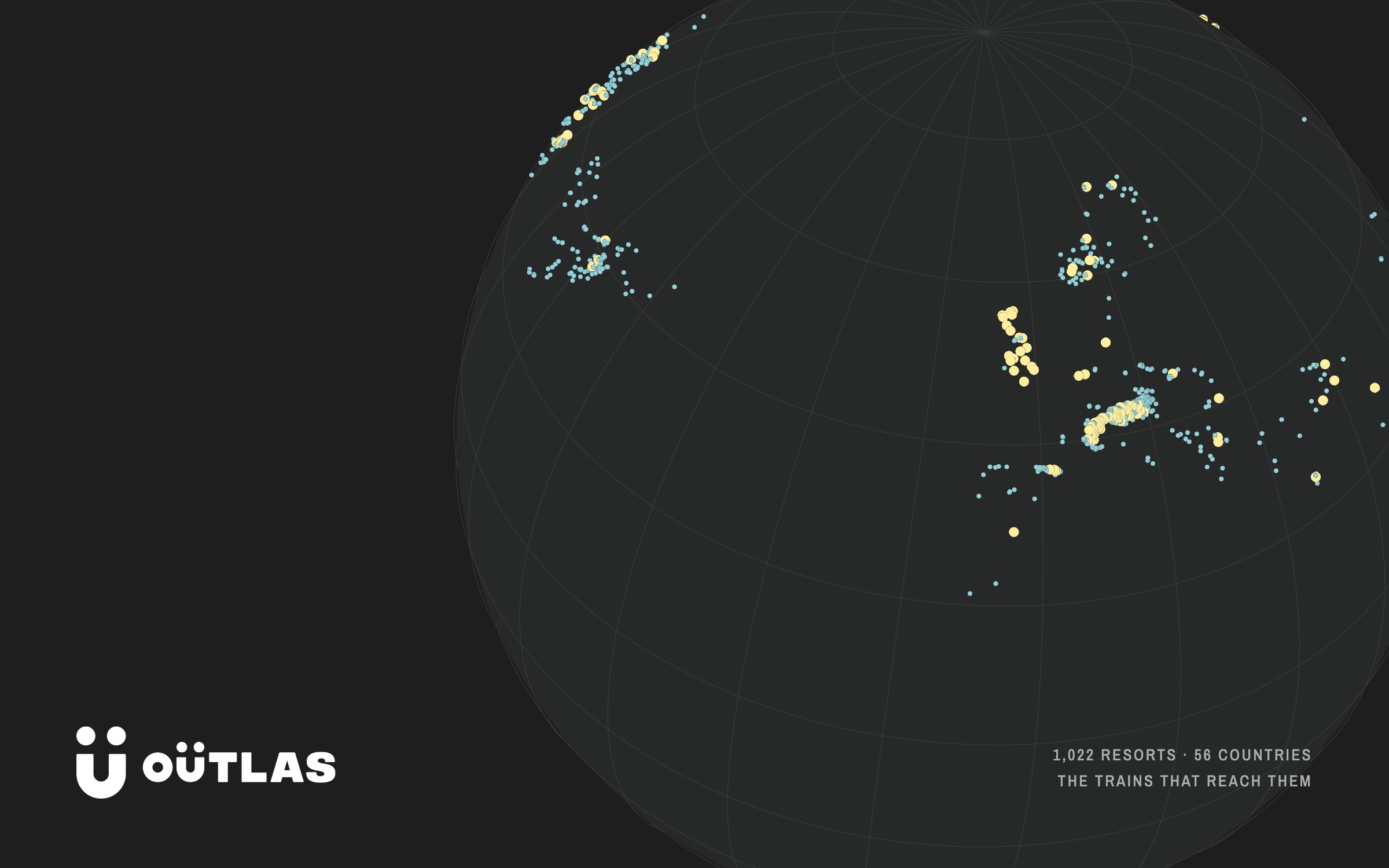
Oütlas is a map for riders who want to reach the mountains without flying. It plots 1,022 ski resorts across 56 countries. Beside each one sit the nearest train station and charge point, and the shops nearby that rent and repair kit instead of selling it.
HUX designed and built it end to end: product, data, design system and front end. The work has shipped as 37 releases to outlas.app.
02 / 08
Challenge
Most of a ski trip's footprint happens before anyone clips in. Transport makes up 52% of a ski day's emissions, and running the resort makes up 3%. Flying from London to Tignes emits about 103 kg CO₂e one way. The same trip by rail emits 18.5 kg.
The tools riders use don't show that trip. Resort sites sell the day on the hill, package operators sell the flight, and the planning happens in group chats. Nobody shows the whole journey from front door to lift, or where to borrow kit once you arrive. Oütlas also carried a long history: a 2018 manifesto, a 2021 pitch and a 2022 business plan, each a different version of one idea.
Sources: ADEME / Utopies, 2022 (share of emissions); Anthesis, 2020 (London to Tignes).
03 / 08
Goal
Make the low-carbon trip the obvious one. A rider picks a range, sees every resort in it, and sees at a glance how to get there by train and where to rent or repair kit on arrival. Every number on screen comes from the data, and every screen works on a phone.
04 / 08
Discovery
We went back through three versions of the business. The 2018 manifesto said buy the service, not the snowboard. The 2021 pitch opened with "Travel light. Consume less. Ride more." The 2022 plan described a private gear club. The line that survived all three became the voice.
Share gear. Buy less. Ride more.
We then audited the data. An Airtable base held the resorts, the nearest stations and the rental and repair shops, with uneven fields across all of them. The climate research set the order of work: travel first, kit second, everything else after.
05 / 08
Strategy
Map first. The map is the home screen, and every record opens beside it, so a rider never loses their place. Regions sit on one axis, from the globe down to a range and then to an area such as the Cairngorms.
Data draws the pictures. Peak, vertical drop, pisted terrain and lifts shape each resort's mountain on one 4,000 m scale, so Glenshee and Chamonix compare honestly side by side.
The design system grew with the product. HUX supplied the structure: token tiers, surfaces as modes and CEL naming. Oütlas kept its own face: six colours, block colour only, and Vollkorn with Archivo Narrow.
06 / 08
Prototyping
Prototypes ran in code from the first day, on Next.js, and went live on Vercel as they were made. Decisions were taken on real data at real speed, with a release note for every deploy.
The anatomy of a resort went through three forms in under two weeks. It started as strata bands, became a contoured 2D peak, and settled as a turning wire mesh in three.js. The mountain system began as a Machinations model of climate, water, travel and jobs, and became a simulator anyone can run in the browser.
07 / 08
Implementation
The build is a Next.js app on Vercel, with Mapbox for the map and three.js for the mountains. Content lives in typed files fed by the Airtable audit, so a new resort is one line of data, and its pin, record and mountain follow from it.
Anatomy of a resort, live. Rebuilt here in three.js from the app's own mesh code. Pick a resort and it rises from flat ground with ease in-out quint, on the shared 4,000 m scale.
Glenshee Ski CentreScotland
08 / 08
Results
1,022
Resorts mapped
56
Countries
150
Mountains drawn
37
Releases
Oütlas is live at outlas.app. The map holds 1,022 resorts in 56 countries, from the Cairngorms to Hokkaido, grouped into 15 mountain ranges and a set of artificial slopes. Rental shops, repair shops and guides sit on the same map, each in its own colour, so the kit question is answered in the same view as the journey.
Every resort with full figures has its own mountain, drawn from data on one scale. The same engine exports social clips straight from the browser. The Stories below were made that way, and rise from flat ground the way the page does.
The design system is a working tool, not a document. Colour, type, motion and data-viz rules live in one token file that the app, the motion pieces and the social exports all read. A rule changed there changes everywhere.
The work also gave the business its next step. The map answers where and how. The Oütlas Riders' Network, now in strategy, adds who: invite-only trips by train, coach and full cars, with kit shared rather than bought or flown. It starts with Scotland, then the Alps by rail.
Instagram Stories exported from the anatomy page, in dark mode.
All flow. No friction.
hamish@hux.works
+44 (0)7832 839 543